
Father Damien of Molokaʻi was a Roman Catholic priest from Belgium who volunteered to serve the isolated settlement at Kalawao in 1873. Authorities had separated people with Hansen’s disease from their families and sent them to the peninsula, where resources were limited.
Damien dedicated himself to the community’s spiritual and practical needs. He worked alongside residents to improve their living conditions, cared for people who were ill, and pressed for more support. In 2009, Pope Benedict XVI canonized him as Saint Damien.
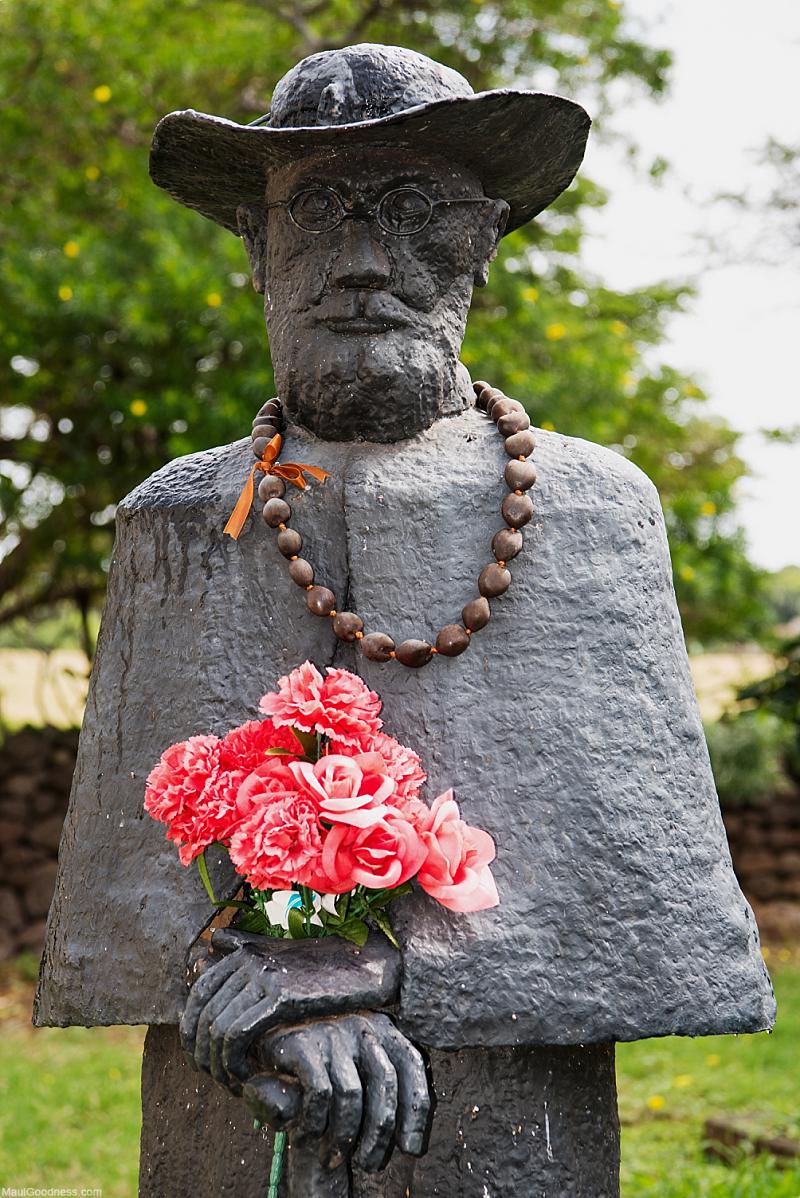
Father Damien statue from the original article. MauiGoodness.com credit retained.
Hansen’s Disease and the Isolation Settlement
When Hansen’s disease, also called leprosy, began to spread in Hawaiʻi, fear and misunderstanding shaped the response. King Kamehameha V signed the Act to Prevent the Spread of Leprosy in 1865. The first group of patients arrived at Kalawao in January 1866.
The law separated people from their homes and families. Kalawao stood on the eastern side of the Kalaupapa Peninsula, on Molokaʻi’s north shore. Ocean surrounds three sides of the peninsula, while steep sea cliffs separate it from the rest of the island.
The Royal Board of Health provided food and supplies, but the early settlement faced serious shortages. Providing shelter, care, and reliable resources was difficult. Residents and those who came to help worked to build a community in these harsh circumstances.
Hansen’s disease is caused by bacteria, not a virus. The National Park Service explains that no one knows when or how it reached Hawaiʻi, although it appears in records from the 1830s. Today, antibiotics can treat it. The long history of stigma is one reason to refer to people by their names or as people with Hansen’s disease, rather than defining them by an illness.
Father Damien’s Life Before Hawaiʻi
Damien was born Joseph De Veuster in Belgium in 1840. Like his older brother Pamphile, he entered the Congregation of the Sacred Hearts. When Pamphile became too ill to leave for a mission in the Hawaiian Islands, Damien went in his place.
Father Damien arrived in Honolulu on March 19, 1864, and received ordination at the Cathedral of Our Lady of Peace that year. Before moving to Molokaʻi, he spent eight years serving communities on Hawaiʻi Island. His work took him through Puna, Kohala, and Hāmākua.
Father Damien’s Mission on Molokaʻi
Bishop Louis Désiré Maigret wanted the patients at Kalawao to have a Catholic priest to assist them. Four priests volunteered to serve in succession, and Damien was the first to go. He arrived at Kalawao on May 10, 1873.
Damien worked with residents to build houses and a water system, plant trees, and organize schools, bands, and choirs. He expanded St. Philomena Catholic Church, cared for people who were ill, and buried those who died. He made it his mission to improve their living conditions.
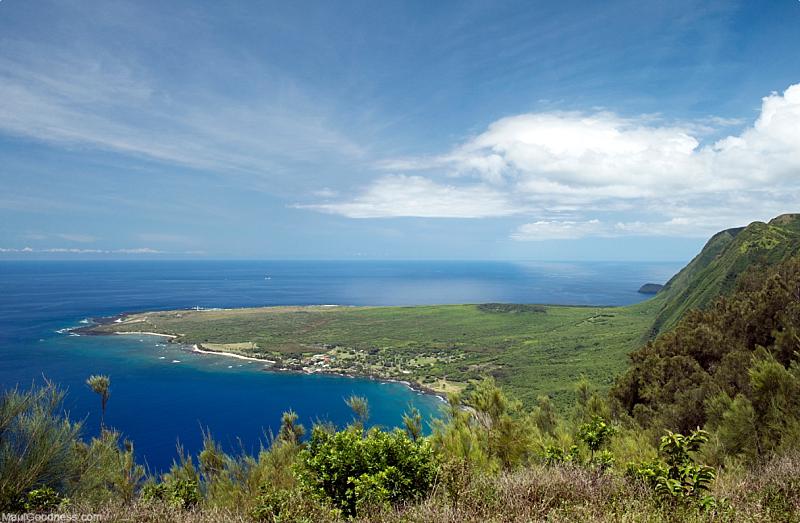
Kalaupapa Peninsula from above, as shown in the original article. MauiGoodness.com credit retained.
His years of service at Kalawao lasted from 1873 until his death in 1889. That was 16 years on the peninsula, in addition to his earlier work elsewhere in Hawaiʻi. Through that time, he offered faith, comfort, and practical help.
Father Damien was the most famous caregiver at Kalawao, but he wasn’t the first or the only one. Residents, family members, friends, and religious workers of several faiths helped sustain the community. Joseph Dutton arrived in 1886. Mother Marianne Cope and two fellow sisters arrived in 1888 and continued caring for residents after Damien’s death.
Illness, Death and Sainthood
Damien was diagnosed with Hansen’s disease in the mid-1880s. Despite the illness slowing him down, he remained involved in the community and wanted to complete as many projects as he could with the time he had left.
He tried Japanese Goto baths, one of the treatments explored at the time. The baths brought some relief, but they weren’t a cure. Modern treatment came much later.
Father Damien died at Kalawao on April 15, 1889, at the age of 49. His first grave was beside St. Philomena Church. In 1936, his remains returned to Belgium for reburial at Louvain, also known as Leuven. A relic of his right hand returned to his original grave at Kalawao in 1995.

St. Philomena Church, shown in the original Father Damien article. Original MauiGoodness.com credit retained.
People around the world have commemorated his service and bravery. His canonization in 2009 recognized a life devoted to people who had been isolated and stigmatized. The National Park Service’s Father Damien history offers more about his work and the people who shared it.
Kalaupapa Today and Planning a Visit
Hawaiʻi ended its isolation laws in 1969. Kalaupapa National Historical Park dates to 1980. Its mission includes preserving the history of the peninsula and the people who lived there.
Kalaupapa is also a living community, and the park restricts access to protect residents’ privacy. According to the park’s current conditions page, general public visits are available only through a park-permitted guided tour. Participants receive a Hawaiʻi Department of Health entry permit through their authorized sponsor.
Check Kalaupapa’s current access conditions before making travel plans. Don’t assume you can walk down the Pali Trail or arrive independently. The overlook at Pālāʻau State Park is another way to see the peninsula from above while visiting Molokaʻi.

We’re a small group of full-time Maui residents that LOVE exploring and writing about what we think is the best place on Earth: The Island of Maui, Hawaii! Expect many more articles, reviews, photos and videos of Maui and all of the Hawaiian Islands. ALOHA!


0 Comments